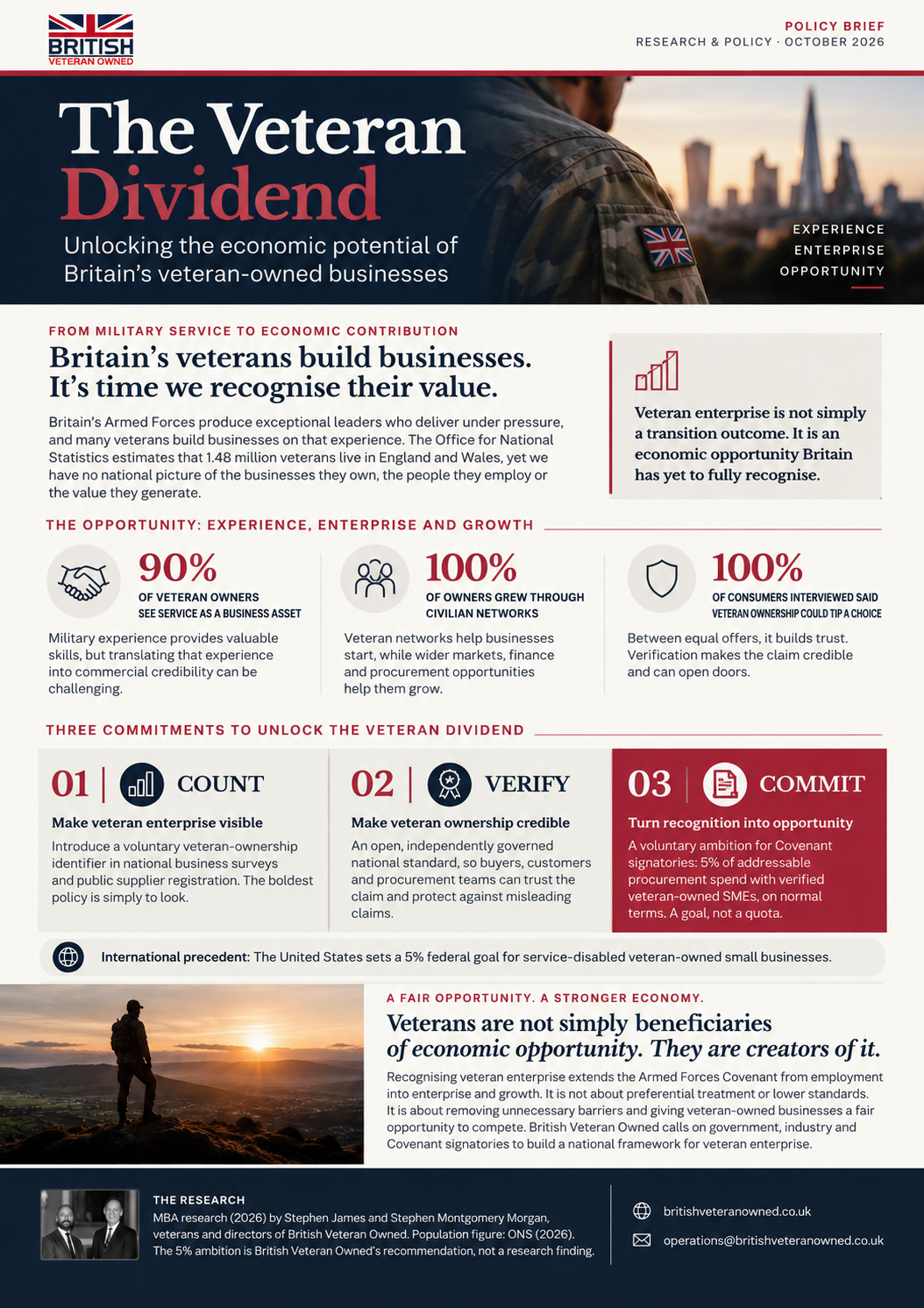
90%
of veteran owners see service as a business asset
Military experience provides valuable skills, but translating that experience into commercial credibility can be challenging.
Unlocking the economic potential of Britain’s veteran-owned businesses.
Our MBA research into UK veteran enterprise was completed on 15 October 2026. This policy brief sets out what we found and three commitments that would turn it into action.
Britain’s Armed Forces produce exceptional leaders who deliver under pressure, and many veterans build businesses on that experience.
The Office for National Statistics estimates that 1.48 million veterans live in England and Wales. Yet we have no national picture of the businesses they own, the people they employ or the value they generate.
Veteran-owned businesses sit between several systems that are usually discussed separately: veteran transition, small business finance, public procurement and social value. This brief argues that they should be treated as one opportunity.
Interviews with veteran business owners and consumers point to the same conclusion. Service is a real asset, but it needs a route into civilian markets and a way to be trusted.
90%
Military experience provides valuable skills, but translating that experience into commercial credibility can be challenging.
100%
Veteran networks help businesses start, while wider markets, finance and procurement opportunities help them grow.
100%
Between equal offers, it builds trust. Verification makes the claim credible and can open doors.
Count it, verify it, commit to it. Each step is voluntary and builds on the one before.
Introduce a voluntary veteran-ownership identifier in national business surveys and public supplier registration. The boldest policy is simply to look.
Without a count, veteran enterprise cannot be measured, supported or planned for. A voluntary identifier costs little and gives government, lenders and buyers the national picture that is missing today.
An open, independently governed national standard, so buyers, customers and procurement teams can trust the claim and protect against misleading claims.
Veteran ownership only works as a trust signal if it is true. A shared standard protects genuine veteran-owned businesses and gives buyers confidence in who they are dealing with.
A voluntary ambition for Covenant signatories: 5% of addressable procurement spend with verified veteran-owned SMEs, on normal terms. A goal, not a quota.
Recognition matters most when it reaches the supply chain. The ambition asks organisations that have already signed the Armed Forces Covenant to extend it from employment into enterprise.
International precedent: the United States sets a 5% federal goal for service-disabled veteran-owned small businesses.
Recognising veteran enterprise extends the Armed Forces Covenant from employment into enterprise and growth.
It is not about preferential treatment or lower standards. It is about removing unnecessary barriers and giving veteran-owned businesses a fair opportunity to compete.
British Veteran Owned calls on government, industry and Covenant signatories to build a national framework for veteran enterprise.
Add a voluntary veteran-ownership question to national business surveys and public supplier registration, and recognise an independent verification standard.
Adopt the 5% ambition for addressable procurement spend with verified veteran-owned SMEs, on normal commercial terms.
Ask suppliers about veteran ownership, check verification and open your supply chains to veteran-owned SMEs.
Get verified, so your service background becomes a credible, checkable part of how buyers see your business.
The Veteran Dividend draws on MBA research completed in October 2026 by Stephen James and Stephen Montgomery Morgan, veterans and directors of British Veteran Owned.
The work combined two connected studies: